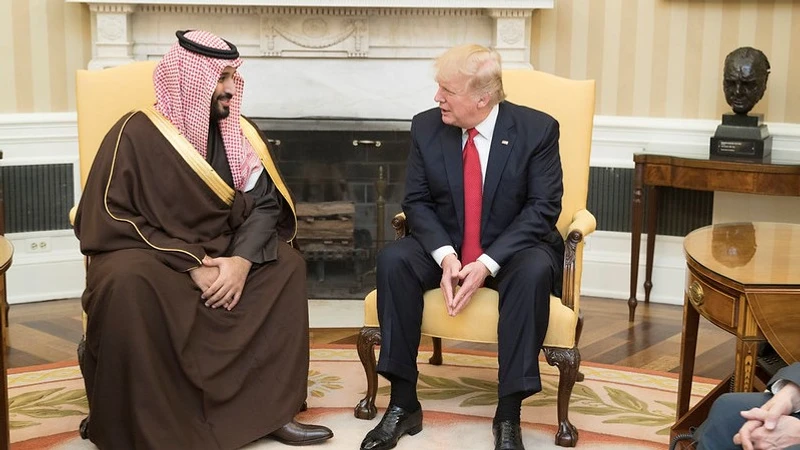
The United States and the Kingdom of Saudi Arabia signed a landmark civil nuclear cooperation agreement on Wednesday, establishing a formal framework for American companies to participate in developing Saudi Arabia's civilian nuclear program, including the potential construction of uranium enrichment capabilities on Saudi soil, according to multiple reports citing officials familiar with the pact.
The agreement, described by sources as a "123 agreement" — named for the section of the Atomic Energy Act of 1954 that governs such deals — sets baseline conditions under which American nuclear technology and expertise can legally be transferred to a foreign partner. The signing represents the culmination of years of negotiations between Riyadh and successive U.S. administrations and comes as Saudi Arabia has openly sought to develop domestic nuclear capacity, both for energy diversification and as a strategic hedge.
Crown Prince Mohammed bin Salman publicly declared in 2018 that if Iran developed a nuclear weapon, Saudi Arabia would pursue one as well. That statement has shaped the backdrop of these negotiations in the years since.
The deal's terms, as reported, would permit American companies to compete for contracts to build nuclear reactors in the Kingdom. What remains contested — and what is expected to drive the coming congressional battle — is the extent to which the agreement limits or permits Saudi Arabia from independently enriching uranium and reprocessing spent nuclear fuel. These two capabilities, in the view of nonproliferation experts, constitute the most sensitive thresholds in civilian nuclear cooperation, because they are technically continuous with weapons-grade production.
A source with knowledge of the negotiations told reporters that Saudi officials had previously resisted agreeing to the so-called "gold standard" — the voluntary renunciation of enrichment and reprocessing rights that the United Arab Emirates accepted as a condition of its own 2009 agreement with the United States. Whether Riyadh has accepted equivalent restrictions in this deal, or whether the agreement preserves ambiguity on that question, had not been confirmed in full as of Wednesday afternoon.
Under the Atomic Energy Act, Congress has sixty days of continuous session to review any 123 agreement after it is submitted by the executive branch. Lawmakers in both parties have signaled they intend to scrutinize the deal's terms closely. Republican Sen. John Cornyn of Texas, who sits on the Senate Intelligence Committee, has previously expressed concern about nuclear technology transfers to Gulf states without iron-clad nonproliferation conditions. Several Democratic members of the Senate Foreign Relations Committee have also signaled skepticism.
The agreement arrives at a moment of escalating regional tension. The United States is currently engaged in open military confrontation with Iran — Saudi Arabia's primary geopolitical rival — following Iranian threats to shipping through the Strait of Hormuz. American service members killed in those operations were received at Dover Air Force Base on Wednesday. Trump administration officials have framed the nuclear deal in part as a strategic deepening of the U.S.-Saudi relationship at a moment when alignment with Gulf partners is viewed as essential to any regional strategy against Iranian expansion.
The deal also has a commercial dimension. American nuclear companies, including those developing advanced small modular reactors, have been in direct competition with Russian and Chinese firms for Saudi contracts. Russia's state nuclear energy company, Rosatom, and China's China National Nuclear Corporation have both been in discussions with Riyadh. A U.S. agreement that unlocks American participation is widely seen within the industry as preventing a strategic loss to near-peer competitors in a market valued in the tens of billions of dollars.
Critics of the deal, including several nonproliferation researchers, have argued publicly that any agreement that does not explicitly prohibit Saudi uranium enrichment creates a precedent that could be exploited by other regional states seeking equivalent treatment. Israel, which maintains undeclared nuclear capabilities and has the most direct security interest in preventing Saudi weaponization, has not publicly commented on the agreement.
What happens next depends largely on what the full text of the agreement reveals when submitted to Congress. The sixty-day review window gives lawmakers the authority to pass a joint resolution of disapproval — though such a resolution would be subject to a presidential veto.
The administration has not indicated whether it plans to submit the agreement to Congress immediately or allow review to begin at a later date.
U.S. and Saudi Arabia Ink Landmark Nuclear Agreement; Congressional Fight Looms
- by: Cole Ryder
- 2026-07-24
- Source:
patriotuncensored.com

- 07/24/2026
