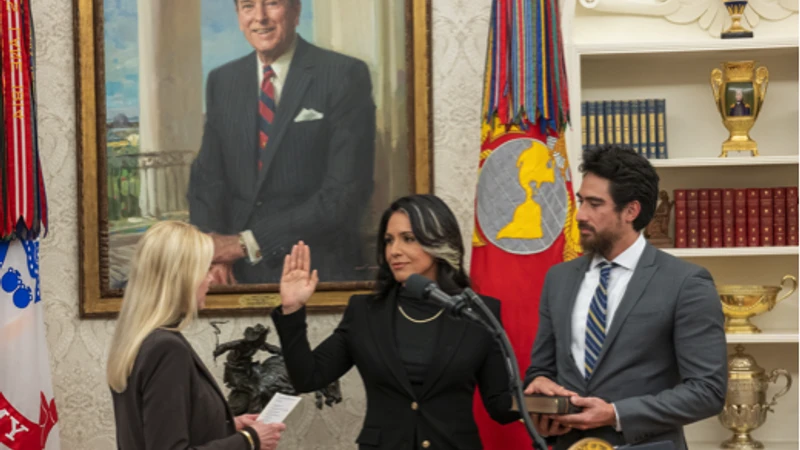
The attacks on Tulsi Gabbard have been relentless. Anonymously sourced hit pieces have hammered the Director of National Intelligence in the Guardian, the New York Times, the Washington Post, the New Republic, CNN, NBC, MSNBC, and virtually every other outlet that serves as a reliable transmission belt for the intelligence community's preferred narratives. Rumors have circulated through Washington that President Trump is displeased with her and that she is on her way out.
None of it appears to be working.
Trump has been unequivocal in his support. When asked on Air Force One last week whether he still has confidence in Gabbard following the incendiary resignation of her top aide Joe Kent — who quit over his opposition to the Iran war — the president was clear. "Sure," he said. "She's a little bit different in her thought process than me, but that doesn't make somebody not available to serve."
He was even more effusive in a conversation last summer, after Gabbard held a bombshell press conference announcing she had sent criminal referrals to the DOJ and FBI implicating former President Barack Obama in the "seditious conspiracy" of the Russia collusion hoax. "Tulsi's done a great job," Trump said. "She's tough and she's smart and she went deep into the files and she found it. Look, this was an attempted coup. A lot of people would not have found it to be politically correct to find it. It would be easier not to."
That assessment cuts to the heart of why the Deep State is so desperate to sideline Gabbard. More than any other official in the Trump administration, she is carrying out the president's express wish to declassify information, bring wrongdoers to account, and shine a public light on the intelligence community's years-long campaign against him — from Russiagate to the Ukraine impeachment to, potentially, the multiple assassination attempts.
Obstructed at Every Turn
What is remarkable about Gabbard's tenure is not just what she has uncovered — it is what she has had to fight through to uncover it. The obstruction comes not only from Democrats and their Deep State allies who are terrified of what the files contain, but from the very agencies that carried out the anti-Trump plots and hid the evidence afterward.
Trump's own appointees — FBI Director Kash Patel and CIA Director John Ratcliffe — have at times allowed their bureaucrats to stymie her work, whether through active turf protection or the passive resistance of entrenched institutionalists who have spent years cultivating the kind of classified secrets that Gabbard is now prying open.
The tensions have occasionally gone fully public. Last October, the FBI sent a sharply worded letter to Congress expressing "strong objection" to a proposal that would have streamlined counterintelligence coordination across the government by designating Gabbard's Office of the Director of National Intelligence as the lead agency. There was friction, too, about her intervention in the FBI's slow-walking of its investigation into election irregularities in Fulton County, Georgia — an investigation Trump himself asked her to oversee.
The CIA has been no more cooperative. When Gabbard declassified a 2020 Republican-led House Intelligence Committee report on Russia's interference in the 2016 election, anonymous CIA officials immediately went to the media invoking the standard "sources and methods" complaint. When she advised Trump to strip security clearances from 37 current and former intelligence officials for "politicization or weaponization of intelligence," unnamed CIA officials accused her of endangering an "undercover" officer — one Julia Gurganus, who had overseen the Obama-ordered intelligence assessment at the center of the Russia hoax and whose photo and CIA credentials appeared publicly on The Atlantic's website.
Sources say Gurganus was hastily redesignated as "undercover" just a couple of months before her security clearance was revoked — a transparent ploy to shield her from accountability. Gabbard also had to battle the CIA bureaucracy simply to release information showing the agency had failed to vet 18,000 known or suspected terrorists who entered the United States in the chaotic aftermath of Biden's catastrophic Afghanistan withdrawal.
What's Coming Next
Despite the institutional resistance at every level, Gabbard presses forward. Several additional bombshell declassification releases from the ODNI are expected in the coming weeks.
Among the most anticipated: transcripts from closed 2019 congressional hearings with former Intelligence Community Inspector General Michael Atkinson, whose whistleblower referral triggered Trump's first impeachment. The transcripts are expected to demonstrate that the impeachment was built on the flimsiest of pretexts — highly spun second- and third-hand accounts of a telephone call between Trump and Ukrainian President Volodymyr Zelenskyy in which Trump asked for assistance investigating Hunter Biden's influence peddling in Ukraine while his father served as vice president. The framing that produced articles of impeachment may be exposed as exactly the kind of manufactured political weapon that Gabbard's declassification campaign has been designed to document.
Also expected: COVID-related files, including a potentially startling accounting of U.S.-funded biological laboratories in Ukraine, China, and elsewhere — material that could reshape public understanding of the pandemic's origins and the role American institutions may have played in funding the research that preceded it.
The Kent Resignation and the Iran Pressure
The recent resignation of Joe Kent — Gabbard's director of the National Counterterrorism Center — and his subsequent media tour criticizing the Iran war have added a new dimension to the pressure campaign against her. Some within the administration have used Kent's departure to suggest that Gabbard harbors similar antiwar and anti-Israel views.
By all fair accounts, that characterization is wrong. Gabbard, a military veteran and former Democratic presidential candidate who joined RFK Jr. as part of the broad coalition that delivered Trump's 2024 victory, has conducted herself with professionalism and dispassion. When she briefs the president on Iran intelligence from the 18 agencies she oversees, she delivers unvarnished facts — each agency's analysis slightly nuanced, providing decision-makers with the most complete picture possible rather than the tunnel-vision assessments that contributed to the intelligence failures preceding 9/11 and the Iraq War.
That is, after all, the entire purpose of having both multiple intelligence agencies and an ODNI to oversee them.
The Stakes — and the Clock
Fifty-four percent of American voters, according to a Rasmussen poll, believe Gabbard's claim that Obama administration officials committed serious crimes by manipulating intelligence to falsely accuse Russia of interfering in the 2016 election on Trump's behalf. Sixty-nine percent demand accountability for those crimes.
And yet accountability is nowhere in sight for Russia hoaxers John Brennan, James Clapper, and James Comey — let alone the nameless bureaucrats still burrowed into the agencies, leaking damaging anonymously sourced stories and doing whatever they can to slow Gabbard's work.
The clock is ticking. If Democrats recapture the House in November's midterms, as some polls suggest they may, the impeachment machinery will start back up, the oversight investigations will be buried, and the window for accountability will snap shut — perhaps for good.
Gabbard knows this. She is digging anyway.
Additional declassification releases from the ODNI, including impeachment hearing transcripts and COVID-related files, are expected in the coming weeks.
Tulsi Gabbard Keeps Digging Into Deep State Secrets — Even as the Deep State Fights Back
- by: Ben Martin
- Apr 9, 2026
- Source:
patriotuncensored.com

- 04/09/2026
