.jpg)
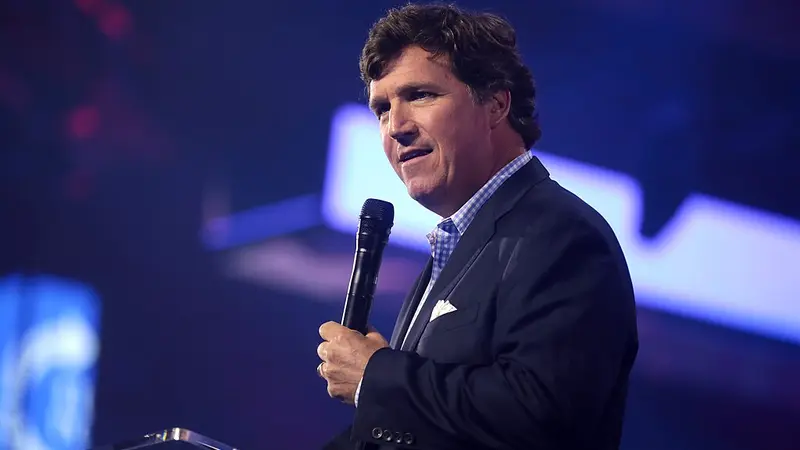
Tucker Carlson has ignited a firestorm within conservative circles and drawn a swift rebuke from the White House after publicly urging White House aides and Pentagon officials to refuse President Donald Trump's orders if they involve mass attacks on Iranian civilians or the possible use of nuclear weapons against Iran.
"Those people who are in direct contact with the President need to say, 'no, I'll resign. I'll do whatever I can do legally to stop this, because this is insane,'" Carlson said on his popular podcast. He went further, telling officials they should refuse to carry out any nuclear-related order and, if necessary, "figure out the codes on the football yourself" — a reference to the briefcase containing the president's nuclear launch codes.
The remarks represent arguably the most high-profile act of public dissent from within Trump's former base since the U.S.-Israel military campaign against Iran began earlier this year, and they have landed like a grenade in an already volatile political environment.
Trump's response was characteristically blunt. Speaking to the New York Post, the president said Carlson is "a low IQ person that has absolutely no idea what's going on." White House officials subsequently clarified that nuclear weapons are "not under consideration" in the Iran campaign.
What Carlson Said — and Why
Carlson framed his remarks around what he described as the moral and strategic catastrophe of mass civilian casualties in Iran, calling potential escalation of that kind "evil" and a desecration of both Christian and Islamic values. Responding specifically to Trump's recent social media rhetoric about reopening the Strait of Hormuz and warnings of overwhelming force, Carlson warned that such actions would mean "a whole civilization will die tonight" and would mark "the end of the American empire as we understand it."
He argued that ordering mass civilian strikes or nuclear action would run directly counter to the "America First" principles on which Trump campaigned — specifically his repeated promises to end America's habit of endless Middle East wars. "Say no, absolutely not," Carlson told his audience, directing the message explicitly at officials with direct access to the president.
The remarks are a dramatic public rupture between Carlson and the Trump administration — one that has been building since the Iran campaign began. Carlson has long been the most prominent media voice within the MAGA ecosystem pushing back against military adventurism in the Middle East, but urging active defiance of a sitting president's orders is a significant escalation even by his standards.
The Growing Anti-War Chorus
Carlson is not alone. A loose coalition of anti-interventionist voices spanning the political spectrum has coalesced around opposition to the Iran campaign's escalating trajectory, drawing comparisons to the neoconservative failures of the Iraq War era.
Independent journalist Glenn Greenwald, who has appeared on Carlson's show multiple times to discuss the conflict, praised Carlson's "herculean" resistance in late March, noting that Carlson had already "sacrificed his relationship with President Trump" by taking a sustained public stand against the war. Greenwald has argued that the administration's posture has shifted dramatically from its earlier rhetoric about "liberating Iranians" into a regime-change campaign that echoes past neoconservative disasters, pointing to what he calls a troubling gap between Trump's campaign promises of restraint and the "large-scale military destruction, including attacks on infrastructure and natural resources" that has followed.
Comedian and political commentator Jimmy Dore, a longtime critic of U.S. interventionism from the anti-establishment left, has hammered the Iran escalation on his show as a betrayal of Trump's "no more forever wars" pledges, linking the conflict directly to soaring domestic gasoline prices and accusing both parties of succumbing to the same "war machine" impulses that defined the post-9/11 era. Libertarian comedian and podcaster Dave Smith, a frequent Carlson guest and consistent critic of the Iran campaign, called Carlson's remarks a defining moment. "I can't believe how hard Tucker just went at Trump and he is legitimately a modern American hero for doing it," Smith wrote on X.
A Debate at the Heart of the Conservative Movement
What makes this moment genuinely significant is not that figures on the left or in the libertarian fringe are criticizing the Iran campaign — that was predictable. It is that the criticism is coming from voices who were among Trump's most loyal and influential supporters, and that it is framed explicitly in terms of betrayal of the America First agenda rather than opposition to Trump himself.
The tension is a real one. Trump ran in 2016 and again in 2024 on a platform that explicitly rejected the interventionist foreign policy consensus that had defined both Republican and Democratic administrations for decades. "No more forever wars" was not a throwaway line — it was a core promise that animated millions of voters who believed the United States had paid an enormous and largely pointless price in blood, treasure, and global standing for two decades of Middle East nation-building.
The Iran campaign, now in its sixth week with no clear endpoint, is testing whether that promise has been kept or quietly abandoned. The White House's position is that the campaign is fundamentally different from the Iraq and Afghanistan occupations — targeted, technology-driven, and aimed at neutralizing a specific and documented threat rather than building a new nation. Trump's ultimatums to Iran, including his recent 48-hour warning that "all hell will reign down," suggest a president who believes overwhelming pressure will produce a negotiated resolution rather than a prolonged occupation.
Carlson and his allies are not convinced — and they are saying so loudly.
The White House Holds Firm
Despite the backlash, the administration has not blinked. White House officials' clarification that nuclear weapons are "not under consideration" was a direct response to the specific alarm Carlson raised, and it drew a clear line between the current campaign's objectives and the catastrophic escalation Carlson was warning against.
Whether that assurance is sufficient to quiet the anti-war wing of Trump's coalition remains an open question. Carlson's audience is large, loyal, and deeply skeptical of military escalation in the Middle East. His willingness to publicly call on government officials to defy the president — a step that would have been virtually unimaginable from him even a year ago — signals how seriously he and his listeners are taking the trajectory of this conflict.
The debate now unfolding within the conservative movement over the Iran war is one of the most significant internal fractures on the right in years. Its resolution will say a great deal about the future direction of the America First movement — and about whether Trump's foreign policy legacy will ultimately be defined by restraint or by escalation.
The White House has confirmed that nuclear weapons are not under consideration in the Iran campaign. Operation Epic Fury continues. Tucker Carlson has not responded to White House requests for comment.
Tucker Carlson Calls on Pentagon Officials to Defy Trump on Iran, Urges Refusal of Nuclear Orders
- by: Ben Martin
- 2026-04-08
- Source:
patriotuncensored.com

- 04/08/2026
