Trump Told You Iran Doesn't Keep Deals. The Burning Tankers Prove It
- by:
- 07/15/2026
- Source:
patriotuncensored.com

- 07/15/2026
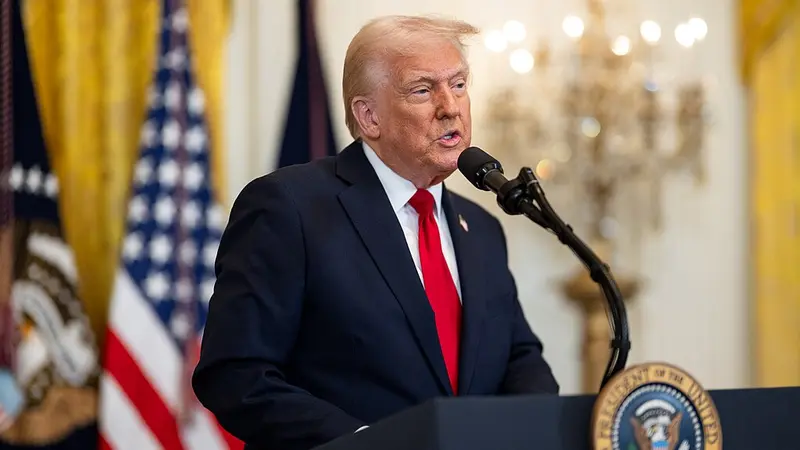
President Trump speaking at the White House by is licensed under Wikimedia

Let's be clear about what happened. The United States negotiated a pause in military operations with the Iranian regime. Months passed. Diplomats talked. Officials briefed reporters about progress. The word "deal" floated through Washington like it meant something.
Then Iran launched cruise missiles into two commercial tankers in the Strait of Hormuz. One mariner is dead. Eight more are wounded. Two ships are on fire.
Here's what you need to understand about that. The regime didn't slip. They didn't miscalculate. This was a choice.
President Trump said it plainly, the way he usually does when he's right: they make deals, and, to them, deals are made to be broken. He said that before the ceasefire. His critics laughed. The foreign policy establishment — the people who've been wrong about Iran for thirty years — called it reckless. They urged patience. More talks. Another agreement with better language this time.
The tankers are on fire. How's that working out?
Trump has formally notified Congress that military operations against Iran have resumed under the War Powers Act. The clock is restarting. And this time, there's a new objective on the table: operational control of the Strait of Hormuz — the choke point through which roughly a fifth of the world's oil flows every single day.
Think about what that actually means. The United States would effectively take charge of the world's most strategically important waterway. Not just protect it. Control it. And charge a transit fee to every nation that benefits from American blood and money keeping those lanes open.
"I want to be reimbursed because we're protecting a very rich portion of the world," Trump told reporters Monday.
That's not warmongering. That's accounting.
Ask yourself something. For decades, the Gulf states have depended on American naval power to keep their shipping lanes open. Saudi Arabia. The UAE. Qatar. Some of the wealthiest nations on earth. And the American taxpayer has been footing the bill for their security. The men and women of the U.S. Navy have patrolled those waters so that Gulf oil can flow freely to Rotterdam and Tokyo and Shanghai. For free. Forever. Without question.
Nobody in Washington ever pushed back on that arrangement. The establishment just assumed it was America's job, indefinitely, gratis.
Trump is the first president in modern history to say: actually, no.
The foreign policy crowd doesn't like it. They never do. The same people who told you the Iran nuclear deal would bring Tehran to heel — who swore the regime was a rational actor amenable to engagement — who promised us a ceasefire would hold — those same people are back on television right now explaining why everything happening is Trump's fault.
Don't fall for it.
Iran has been at war with the United States, in one form or another, since 1979. They took American hostages. They funded Hezbollah. They backed the militias that killed American soldiers in Iraq. They built the nuclear program every administration promised to stop. They negotiated deals and then violated them — every single time.
The Iranian parliament speaker made it plain just recently. He said, out loud, that his regime views negotiations not as a path to reconciliation but as "another instrument of leverage." He wasn't hiding the strategy. He was announcing it.
And the ruling class still pushed the ceasefire.
"We gave them a chance," Trump said Monday.
He's right. They got their chance. One mariner is dead in the Strait of Hormuz because the establishment kept extending those chances to a regime that reads generosity as vulnerability.
There's nothing complicated about this. The regime attacked commercial shipping in international waters. The United States has now resumed military operations with the explicit goal of taking strategic control of the waterway and making other nations pay for the privilege of the protection we provide.
Is that messy? Yes. Is it a departure from decades of foreign policy orthodoxy? Obviously. Does it carry real risks? Of course it does. Every honest option carries risks.
What doesn't carry risk, apparently, is doing the same thing that has failed for forty years. What doesn't get questioned is the endless cycle of deal, violation, negotiation, and deal again — presided over by the same credentialed experts who've never been held accountable for a single failure.
The war is back on. The regime chose it. Trump is prosecuting it with a clarity of purpose that should terrify exactly the people it's terrifying.
The ones who've been wrong about every bet they've placed in the Middle East for four decades.
President Trump speaking at the White House by is licensed under Wikimedia
