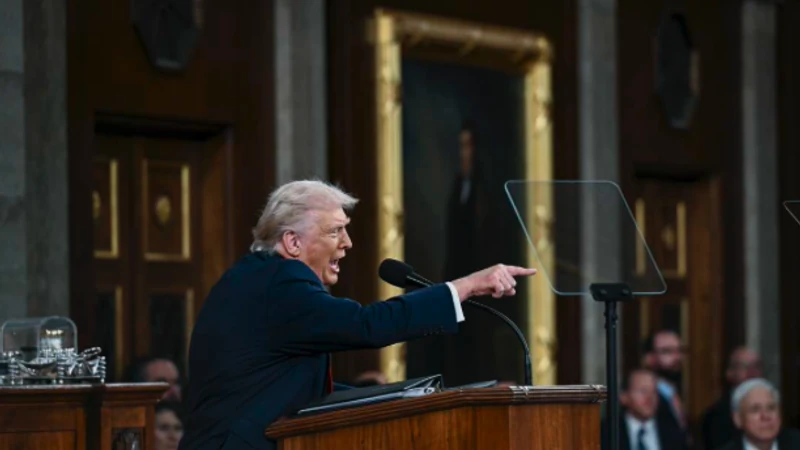
President Donald Trump used his State of the Union address Monday night to formally declare what he called a "war on fraud," placing Vice President JD Vance at the helm of an ambitious effort to root out what the president described as a systematic plundering of American taxpayer dollars. The announcement, delivered to a joint session of Congress and a nationwide television audience, marked one of the most forceful public commitments any president has made to tackling government fraud and the abuse of federal benefits programs.
"Tonight, although it started four months ago, I am officially announcing the war on fraud, to be led by our great Vice President, JD Vance," Trump declared. "He'll get it done. We will actually have a balanced budget overnight. It'll go very quickly. That's the kind of money you're talking about."
The president's remarks were direct, sweeping, and pointed squarely at what he characterized as a crisis of corruption bleeding the country dry. He singled out Minnesota as the most glaring example of the problem, citing what he described as an estimated $19 billion pillaged from American taxpayers — a figure he suggested may actually be even higher — while also naming California, Massachusetts, and Maine as states where the problem is equally severe if not worse.
"This is the kind of corruption that shreds the fabric of a nation," Trump said.
The Minnesota Scandal: A Cautionary Tale
The president's focus on Minnesota is well-founded. The state has become the epicenter of one of the largest federal fraud scandals in recent American history, centered largely on the abuse of pandemic-era food assistance programs. The Feeding Our Future scandal alone involves an estimated $250 million in fraudulently obtained funds, part of a broader web of fraud totaling roughly $9 billion in taxpayer money. To date, 85 individuals have been charged in connection with the scheme, with 60 convictions already secured.
The scale of the fraud is staggering on its own. But what has further inflamed conservative lawmakers is the response — or lack thereof — from Minnesota's top law enforcement official. Senator Josh Hawley (R-MO) has called for the indictment of Minnesota Attorney General Keith Ellison, a Democrat, over accusations that he accepted campaign contributions from individuals connected to the Somali fraud network after they met with him and reportedly sought his assistance regarding ongoing investigations into the scheme. Whether those allegations lead to charges remains to be seen, but the optics are deeply troubling for an attorney general who should have been leading the charge against fraud in his own state.
Immigration, Fraud, and a Pattern of Abuse
Trump did not shy away from connecting the fraud epidemic to broader immigration policy failures, arguing that importing cultures characterized by lawlessness through unrestricted immigration ultimately harms ordinary Americans.
"In large parts of the world, lawlessness is the norm, not the exception," Trump said. "Importing these cultures through unrestricted immigration and open borders brings us problems right here to the USA, and it is the American people who pay the price in higher medical bills, car insurance, rent, taxes, and, perhaps most important, crime."
Those remarks draw on a body of testimony and evidence that has been building in Congress for months. In February, former foreign service officer Simon Hankinson testified before the Senate Judiciary Committee that Somali nationals routinely lied on their immigration applications to obtain visas to the United States. According to Hankinson, applicants systematically misrepresented their age, name, identity, marital status, occupation, purpose of travel, wealth, income, relatives in the United States, and stated intention to return home. Crucially, Hankinson drew a direct line between visa fraud and welfare fraud — arguing that dishonesty in the immigration process carries over into dishonest exploitation of American benefit programs once individuals are inside the country.
It is a connection that challenges the comfortable narrative that immigration fraud and welfare fraud are separate, unrelated problems. If Hankinson's testimony is accurate, they are two sides of the same coin — and the American taxpayer is footing the bill for both.
Legislative Action Underway
Congress has not been idle. Representative Brandon Gill (R-TX) introduced legislation in early February proposing a 25-year moratorium on immigration from Somalia, citing both a failure to assimilate and rampant abuse of federal benefits programs. The bill would amend Section 212 of the Immigration and Nationality Act to bar immigration relief for certain Somali citizens for a quarter century, while preserving existing lawful status and honoring American treaty obligations. The legislation would also codify President Trump's Proclamation 10998, putting the moratorium on firm statutory footing.
The Trump administration has already moved on a parallel track. In mid-January, the Department of Homeland Security announced it was ending Temporary Protected Status for thousands of Somali nationals. DHS Secretary Kristi Noem stated plainly that Somalia no longer meets the legal requirements for TPS designation and that allowing Somali nationals to remain in the country on temporary status is "contrary to national interests."
Taken together — the end of TPS, the proposed immigration moratorium, the Senate testimony on visa fraud, and the ongoing criminal prosecutions in Minnesota — a comprehensive picture is emerging of an administration and a Republican Congress determined to close the loopholes that have allowed this level of fraud to flourish.
Vance Takes the Wheel
The decision to put Vice President Vance in charge of the fraud initiative is a significant one. Vance has proven himself a sharp, aggressive advocate for the America First agenda, and his elevation to lead this effort signals that the administration views it as a top-tier priority rather than a bureaucratic side project. With the Vice President's office driving the effort, it will be harder for federal agencies to slow-walk investigations or bury findings in interagency red tape.
Trump suggested the financial stakes are enormous — large enough, he implied, to effectively balance the federal budget if the fraud is fully recovered and the programs are properly reformed. Whether that ambitious projection is fully realized remains to be seen, but the underlying point is valid: the sheer volume of fraudulently obtained taxpayer funds flowing through federal benefit programs represents an unconscionable drain on the American economy and an insult to the law-abiding citizens who fund it.
For years, the political will to seriously confront this problem was simply absent in Washington. Monday night, in front of the entire nation, President Trump declared that era is over.
The war on fraud initiative, led by Vice President JD Vance, is officially underway. Further details on the scope and structure of the effort are expected in the coming weeks.
Trump Declares War on Fraud at State of the Union, Puts JD Vance in Charge
- by: Ben Martin
- 2026-02-25
- Source:
patriotuncensored.com

- 02/25/2026
