
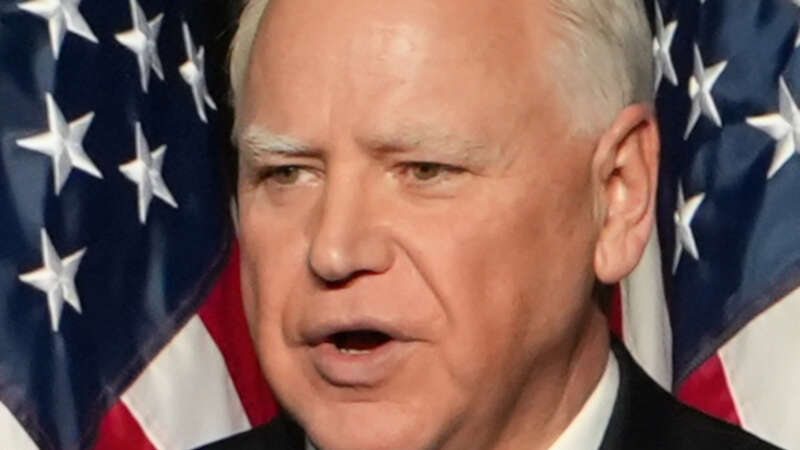
This past weekend, Connecticut Senator Chris Murphy and Minnesota Governor Tim Walz traveled to Barcelona, Spain, where they took the stage alongside four sitting heads of state — Spain's Prime Minister Pedro Sánchez, Brazil's President Lula da Silva, Colombia's President Gustavo Petro, and Mexico's President Claudia Sheinbaum — at an event its organizers titled, without evident irony, the "Global Progressive Mobilisation forum in defense of democracy."
Let us begin there. With the naming.
Thucydides, in his account of the stasis at Corcyra, observed that civil conflict corrupts language before it corrupts institutions: "Words had to change their ordinary meaning and to take that which was now given them." What was rashness became courage. What was prudence became cowardice. What was deliberation became weakness. This inversion of language, Thucydides understood, was not incidental to political decay but constitutive of it. The faction that controls the vocabulary controls the moral terrain. This insight is as applicable to modern progressivism as it was to fifth-century Athens. "Democracy" is invoked most loudly by those working hardest to override democratic outcomes. "Resistance" describes the behavior of those who lost elections and declined to accept the verdict. "Defense of democracy" is the banner under which prominent American officials flew to Barcelona to coordinate, on foreign soil, with a coalition of foreign leaders whose own democratic records are, at best, complicated.
This distinction matters more than it might initially appear, and understanding why requires some historical patience.
Tocqueville, observing American democracy in the 1830s, identified with prophetic precision the characteristic danger that would eventually threaten self-governing republics. It would not come from conquest. It would come from what he called "soft despotism" — the rise of an administrative class that, convinced of its own superior wisdom and beneficence, would gradually extend its tutelage over every aspect of civic life. The tutors, Tocqueville warned, would cover society "in a network of small, complicated, painstaking, uniform rules through which the most original minds and the most vigorous souls cannot clear a way." The result would not be tyranny in the classical sense. It would be something more insidious: citizens reduced to "timid and industrious animals, of which government is the shepherd."
What Tocqueville could not have fully foreseen was that the tutelary class would eventually become transnational — that the administrators would network across borders, coordinate agendas across jurisdictions, and develop a primary loyalty not to any particular people but to an ideological project whose ambitions are explicitly supranational.
That is precisely what Murphy and Walz attended in Barcelona.
They did not travel to Spain to represent American interests at an international forum. They traveled to participate in a summit of the global left — a gathering of politicians whose domestic programs have, in country after country, produced outcomes that the voters of those countries have increasingly repudiated. Brazil's Lula presided over the earlier PT governments during which the Petrobras corruption scandal — by some measures the largest single corruption case in recorded history — metastasized through Brazil's state-owned enterprises and political class. Colombia's Petro, a former urban guerrilla whose youthful associations with the M-19 movement are well documented, has overseen an economic nationalist program that has driven private investment out of the country at historic rates. Mexico's Sheinbaum is the heir to the Obradorista project, which spent six years systematically weakening Mexico's independent judiciary and concentrating power in the executive — the very institutional degradation that Sheinbaum has continued and formalized. Spain's Sánchez has governed through persistent constitutional controversy, including an amnesty law for Catalan separatist leaders that his own justice minister initially called unconstitutional.
These are the champions of democracy alongside whom Murphy and Walz chose to stand.
Hamilton, writing in Federalist No. 68, warned against men of "talents for low intrigue and the little arts of popularity" — politicians whose gifts run to the manipulation of sentiment rather than the cultivation of genuine statesmanship. The men and women who gathered in Barcelona are politically skilled. They are not without talent. But the talent on display this weekend was not the talent of governance. It was the talent of international coalition-building for domestic political purposes — the art of obtaining foreign validation for an agenda that domestic electorates have in significant measure rejected.
The Founders were explicit on this point. The representative's authority derives entirely from the people he serves. It is not portable. It does not transfer to foreign summits or international movements. The senator who stands in Barcelona receiving the approbation of Brazil's Lula and Colombia's Petro is not carrying Connecticut's interests abroad. He is carrying an international ideological agenda home to Connecticut and presenting it, in the language of democracy, as common sense.
This is what Polybius identified as the terminal tendency of constitutional republics — the stage he called anacyclosis, in which a governing class loses its moorings to the people it serves and begins to govern instead for itself and its ideological allies. Cicero recognized the same pattern in the late Roman Republic, where factional identity had begun to supersede civic obligation. The constitutional structures remain. The vocabulary of public service persists. But the actual object of loyalty has shifted from the people to the party, from the nation to the movement, from the republic to the project.
Murphy and Walz will return from Spain. They will speak again, and at length, about threats to democracy, about the importance of democratic norms, about the need to resist authoritarian tendencies. They will do so having given no public account of the weekend they spent on a stage in Barcelona with Pedro Sánchez, Lula da Silva, Gustavo Petro, and Claudia Sheinbaum — four leaders whose commitment to democratic norms is, by any dispassionate measure, substantially qualified.
The republic has endured contradictions of this kind before. It has endured men who spoke of public service while pursuing private ideology, who invoked the people while consulting the movement. It has endured them, but not without cost. Every generation that fails to name the contradiction clearly pays for that failure in the subsequent one.
Western civilization was not built by men who flew to the capitals of foreign ideologues to receive their blessing. It was built by men who understood that ordered liberty requires tending — that the republic's inheritance is not self-sustaining but depends on citizens and leaders willing to put the nation's permanent interests above the ideological fashions of the moment.
That reckoning will come, as it always does, regardless of what conclusions were drawn in Barcelona.

.jpg)