Alexis de Tocqueville, writing of democratic despotism in Democracy in America, described a system that would not tyrannize through violence but through the steady degradation of citizenship — a society in which an "immense and tutelary power" would keep citizens "in perpetual childhood," covering the surface of society "with a network of small complicated rules, minute and uniform." He envisioned an authority that would not break wills so much as soften them, not forbid but prevent, not punish but enfeeble.
June has arrived. And with it, yet another demonstration of how prescient Tocqueville was.
The claim that institutions are neutral is among the most persistent fictions in American public life. Universities have claimed it. Major corporations have claimed it. Sports leagues, professional associations, regulatory agencies, and media organizations have all, at various moments, wrapped themselves in the language of impartiality. But a neutral institution, by definition, does not decorate its walls, its social media feeds, or its employees' uniforms with the symbols of a particular political movement. Neutrality is proved by its absence from controversy — not by its selective participation in one side of it.
For more than a decade, American institutions abandoned that pretense every June. They flew flags. They issued proclamations. They pushed content to employees and customers who had not asked for it and could not easily decline it. Major League Baseball, the NFL, corporate retailers, federal agencies, and the State Department under multiple administrations subordinated their stated missions to the demands of a political movement. And they called it inclusion.
Marco Rubio's State Department issued a directive this year that cut through the pretense. No Pride flags at American embassies. No "public diplomacy outreach" commemorating Pride Month. The order was simple, almost bureaucratic in its plainness. It was treated by the institutional press as an act of aggression. In fact, it was the restoration of something that had been quietly surrendered: the appearance, and to some degree the reality, of government neutrality.
That the order was treated as radical tells us everything about how far the drift had gone.
The Roman republic understood something that modern democracies have largely forgotten: that institutions derive their legitimacy from the perception that they serve everyone. Cicero's res publica — the "public thing" — was precisely that: not the property of a faction but of the whole. When Roman institutions became instruments of factional interest, as they did in the late republic, the republic did not survive it. Not immediately. The decay was gradual, almost invisible year by year, devastating across generations.
We are not Rome. But the principle holds. When the instruments of common life are captured by a faction and made to signal that faction's values, ordinary citizens are forced into a choice they should not have to make: participate and endorse, or withdraw and protest. Neither option is acceptable. Neither preserves the commons.
That is precisely the condition Pride Month has imposed on American institutional life. The Federalist noted this week what should be obvious: institutional neutrality is a lie when one political movement is permitted to occupy the infrastructure of common life every June with the blessing of the institutions themselves. The MLB, the NFL, the publicly traded corporation, the federal embassy — none of these are religious organizations, none are advocacy groups, none were established to advance a particular vision of sexuality and identity. They were established to play baseball, move goods, advance American interests abroad. The moment they allowed themselves to be annexed by a political movement, they ceased to be what they claimed to be.
This matters not merely as a point of institutional hygiene. It matters because children are watching.
Tocqueville also wrote about the role of religious belief and social custom in preserving republican self-governance. He observed that the American experiment depended not merely on legal structures but on the "habits of the heart" — the mores, the character, the moral seriousness of the citizens themselves. He was explicit that the Christianity embedded in American civic life was not incidental to its health but essential to it. A republic, in his view, could not sustain itself on procedural rules alone. It required a people formed by something sturdier than appetite.
The permanent things — the structures of family, the cultivation of virtue, the belief that certain obligations precede the individual's preferences — are not conservative hobbyhorses. They are the load-bearing walls of any civilization that wishes to endure. When institutions celebrate the sovereign self as the highest human value, when they make pride in individual appetites the animating theme of a full calendar month, they are not being neutral. They are making a philosophical claim of enormous consequence — one that has no basis in classical virtue, natural law, or the Christian inheritance that built the West.
Two years into the Trump administration, something is shifting. Corporate America's Pride pivot, as the Daily Wire observed, is unmistakable. Target has quietly scaled back. Embassy flags have come down. The institutional fervor of three years ago is cooling. Whether this represents genuine reconsideration or mere prudential calculation is impossible to know from the outside. What is clear is that the institutions are discovering something they probably knew all along: the performance of ideological neutrality requires actually performing it, not just claiming it when convenient.
That is not a small thing. The habits of civilizations are built slowly, eroded slowly, and recovered slowly. But they can be recovered. Thucydides wrote of the Athenians that their decline came not from external conquest but from the internal dissolution of the civic virtues that had made them great — the willingness to subordinate private interest to public good, to accept common standards, to recognize that the city existed before the citizen and would endure after him.
The question before American institutions today is whether they can relearn what they pretended to know: that a common culture requires common space. That neutrality, real neutrality, means that no faction gets to decorate the commons with its symbols every spring.
Secretary Rubio's order did not purge an ideology. It removed a flag. But the flag was not decorative. It was declaratory — a statement about who the institution serves and what it believes. Removing it is the beginning, not the end, of the harder work: rebuilding institutions that belong to everyone, that serve their stated missions, and that resist the colonization of common life by factional demands.
That work is, in the end, a moral reckoning. Not a political prescription. The republic does not recover because the right people win elections. It recovers because its citizens — and eventually its institutions — choose to rebuild the habits of the heart that make self-governance possible.
That choice is available. June is a good month to begin making it.
The Lie of Institutional Neutrality: What Pride Month Reveals About Who Controls the Cathedral
- by:
- 2026-06-02
- Source:
patriotuncensored.com

- 06/02/2026
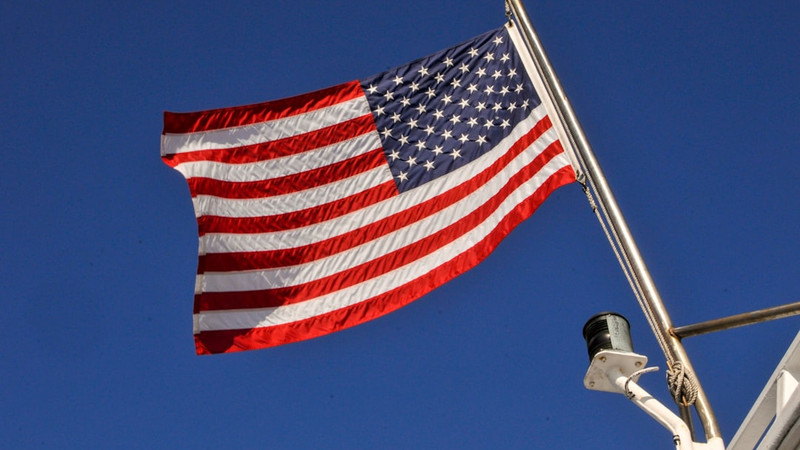
USA American national flag - Star-Spangled Banner by Zetong Li is licensed under Unsplash unsplash.com
USA American national flag - Star-Spangled Banner by Zetong Li is licensed under Unsplash unsplash.com
