Iranian weapons debris keeps falling from the Middle East sky — blown to pieces, electronically crippled, or intercepted before they ever reach their targets. It is the most visible sign of what military analysts are calling an unprecedented deployment of American technological superiority, one that is reshaping the face of modern warfare in real time.
Operation Epic Fury has become a showcase for the full arsenal of 21st century American military capability: heat-seeking satellites, military-grade malware, radar-jamming software, laser weaponry, and the coordinated intelligence power of the U.S. Space Force and Cyber Command — all working in concert to dismantle Iran's military infrastructure with surgical precision and minimal American casualties.
Laser Weapons Enter the Battlefield
Among the most striking revelations to emerge from the conflict is the confirmed deployment of new-technology laser weaponry against Iranian targets. A U.S. Navy destroyer positioned off the coast of Iran has been fitted with what appears to be the High-Energy Laser with Integrated Optical Dazzler and Surveillance system, known as HELIOS, according to videos released by U.S. Central Command and analyzed by military observers.
The HELIOS system is a state-of-the-art directed energy weapon featuring a steerable head capable of concentrating an intense, tightly focused beam of energy to neutralize drones and other aerial threats. The deployment marks one of the first confirmed combat uses of advanced laser weaponry by U.S. forces in a major military operation — a milestone that weapons developers and defense analysts have been anticipating for years.
The results on the battlefield have been striking. During the first 72 hours of Operation Epic Fury, U.S. forces struck 1,700 targets. More than 200 of Iran's ballistic missile launchers — roughly half of the nation's total inventory — have been destroyed, with dozens more rendered inoperable. Hundreds of missiles have been eliminated before they could be fired. All of this has been accomplished with only six American casualties in four days of fighting.
Space Force: Watching From Above
The precision and speed of the American strikes have been made possible in large part by the U.S. Space Force, the branch established in 2019 that is now proving its worth in its first major combat role. Operating primarily from within the United States, Space Force personnel are providing the real-time intelligence that allows air and sea forces to know where and when to strike, when to take cover, and precisely where enemy missiles are located.
"They can spot the missiles and pinpoint where the launchers are," said Brent David Ziarnick, a former professor in the Space Force program at Johns Hopkins University and a retired U.S. Air Force officer. "The missiles can be intercepted and destroyed. Field forces get notified that an attack is coming, so they can go to shelters or bunkers."
The system works through satellites equipped with infrared sensors that detect the heat signature of a missile the instant it launches. That data feeds into a three-layer early warning network consisting of satellites, ground-based radar, and radar domes — known as Radomes — that resemble enormous golf balls and receive real-time information from the sky. The Radomes calculate the trajectory and likely destination of incoming missiles within seconds, enabling rapid response. According to ABC News, hundreds of Iranian missiles have been destroyed using this technology.
"The system is built to ensure, if a missile is ever launched, the United States will be the first to know about it," said Sam Eckhome, host of the YouTube program Access Granted. "Together, the three layers form one of the most advanced early warning networks in the world."
Former Space Force Colonel Bree Fram, who is now running for Congress in Virginia, said the low American casualty count is a direct reflection of the technological edge the United States has brought to the conflict.
"The fact that this isn't a mass formation of troops with rifles on the ground speaks to the fact that this force is built with extreme technology and the brain power to operate it," Fram told The New York Post. "Those combine to make us the most capable force on Earth and keep Americans safe from harm as they do the most difficult, inherently risky things that we ask them to do."
Cyber Command: Turning Iran's Systems Into Bricks
Working in close coordination with Space Force is U.S. Cyber Command, which struck Iranian communications and sensor networks before a single kinetic shot was fired in the operation. Joint Chiefs of Staff Chairman General Dan Caine confirmed at a press conference Monday that Cyber Command's opening moves targeted "communications and sensor networks" across Iran to "disrupt, disorient and confuse the enemy" — effectively blinding Iranian military forces before the physical strikes began.
The approach is both elegant and devastating. Space Force identifies the location of Iranian radar installations; Cyber Command then infiltrates and disables them. "Space Force figures out where the radar is, then work with Cyber Command to jam it," Ziarnick explained. "Cyber Command will try to make their radar not work. It will involve infiltrating the system and shutting it down — or taking it over. The software goes and the computer turns into a brick."
Iran attempted to limit the damage by cutting off all internet access across the country as soon as the American offensive began — a move the regime has used previously to suppress domestic uprisings. But that defensive measure offers limited protection against a Cyber Command capable of penetrating closed-circuit internal networks. Ziarnick was blunt about the implications: "They can reach out and touch people. It's now a force to be reckoned with."
Mossad's Years-Long Surveillance Operation
Adding another layer to the already remarkable intelligence picture, Israeli cyber operatives revealed Tuesday that Mossad spent years hacking nearly every traffic camera in Tehran, building a comprehensive surveillance network that proved critical in tracking and ultimately eliminating Iranian Supreme Leader Ayatollah Ali Khamenei. According to the Financial Times, Mossad's operatives used the camera network to identify Khamenei's security detail, locate where his guards parked their vehicles, obtain their home addresses, and map his movements and protective arrangements over time.
The revelation underscores the depth and sophistication of the U.S.-Israeli intelligence partnership that has underpinned Operation Epic Fury — and suggests that the groundwork for the operation was being laid long before the first missile was ever fired.
A New Era of American Military Power
Taken together, the technologies being deployed in Operation Epic Fury — laser weapons, infrared satellites, radar-jamming malware, Radome networks, and years of embedded intelligence — represent the most comprehensive demonstration of American military technological superiority in a generation. The results speak for themselves: half of Iran's ballistic missile capability destroyed, its supreme leader killed, its communications crippled, and its military disoriented — all within days, and with a fraction of the American casualties that previous conflicts of similar scale would have demanded.
As War Secretary Pete Hegseth declared Wednesday, "America is winning decisively, devastatingly and without mercy." The technology behind Operation Epic Fury is making sure of it.
Operation Epic Fury is ongoing. Further updates from U.S. Central Command and the Department of Defense are expected as the operation continues.
Lasers, Space Force, and Cyber Warfare: The Cutting-Edge Technology Winning Operation Epic Fury
- by: Ben Martin
- March 05, 2026
- Source:
patriotuncensored.com

- 03/05/2026
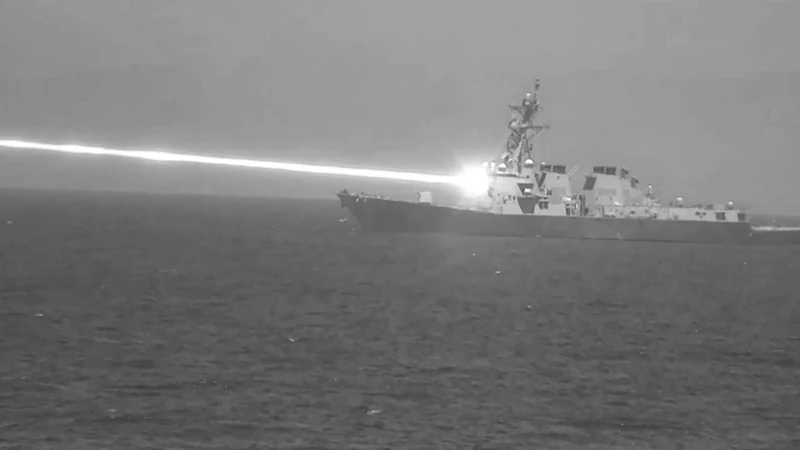
U.S. Navy's HELIOS system by Mass Communication Specialist Seaman Elisha Smith is licensed under U.S. Department of the Navy
U.S. Navy's HELIOS system by Mass Communication Specialist Seaman Elisha Smith is licensed under U.S. Department of the Navy
