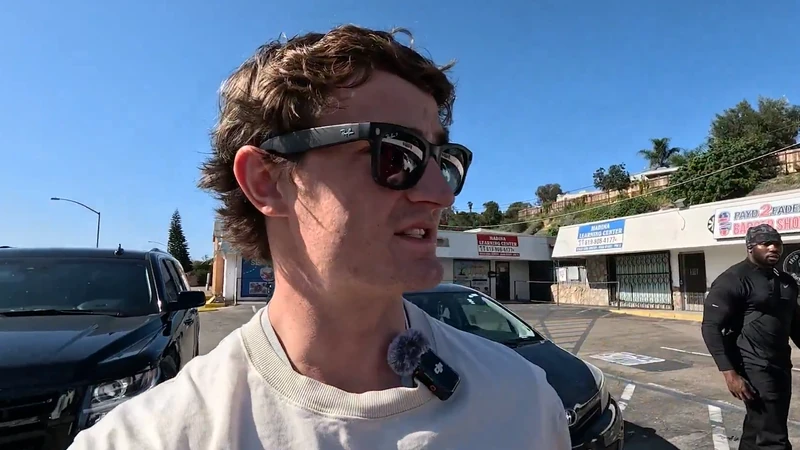
Independent journalist Nick Shirley — who rose to national prominence after exposing massive fraud in Minnesota's government-subsidized program network — has turned his camera on California, and what his team found makes Minnesota look like a warm-up act. Shirley and his team say they uncovered more than $170 million in alleged fraud tied to home healthcare, hospice centers, and daycares across the state, with Los Angeles County at the epicenter of what he is calling one of the most brazen taxpayer rip-offs in American history.
"Minnesota was big but California is even bigger," Shirley posted to X alongside his video report. "We uncovered over $170,000,000 in fraud as these fraudsters live in luxury with no consequences. Like it and share it, the fraud must STOP."
His message to taxpayers was direct: "We ALL work way too hard and pay too much in taxes for this to be happening. These fraudsters have been able to defraud American taxpayers for years without any pushback from the public and politicians. It is time to EXPOSE IT ALL and end America's fraud crisis."
The Numbers Tell a Damning Story
Before Shirley's team even knocked on a single door, the data alone raised serious red flags. Spending through Medi-Cal — California's version of Medicaid — has doubled since 2022. Hospice care in Los Angeles County has seen a staggering 1,000 percent increase in recent years. And according to Mehmet Oz, Administrator for the Centers for Medicare and Medicaid Services, a jaw-dropping 18 percent of all home health care billing in the entire United States originates from Los Angeles County alone — a single county in a single state accounting for nearly one in every five home healthcare dollars billed to the federal government. "One in every $10 that goes towards home healthcare in the US is spent in LA County," Shirley noted in his report. For a county that represents roughly one percent of the national population, that figure is not just anomalous — it is a flashing red alarm.
Empty Daycares, Locked Doors, and Luxury Cars
Shirley's ground-level investigation produced footage that is difficult to explain away. His team visited multiple daycares — several operated by members of the Somali community — and found that in multiple instances there were either no children present at all or far fewer children than the number registered in official government records. In one particularly glaring case, state inspection records showed that every single time an inspector arrived at a facility, no children were present. Yet the government funding kept flowing.
At another daycare, children were visible outside — but no supervising adults were anywhere to be found inside the building. The facilities were collecting public money ostensibly to provide childcare services that, based on what Shirley's cameras documented, were not being provided.
The hospice industry investigation was equally troubling. Shirley visited a commercial plaza in Los Angeles that housed dozens of home hospice centers — an extraordinary concentration of such businesses in a single location. When his team knocked on the doors of these businesses during normal working hours, nobody answered at multiple locations. The businesses were registered, receiving government reimbursements, and — at least on the days Shirley visited — apparently operating no actual services.
What the hospice centers did have in abundance was luxury vehicles. Mercedes, Teslas, and other high-end cars filled the parking lots of businesses that could not produce a single patient or employee willing to speak on camera. At one location, a man who claimed his hospice business was legitimate responded to Shirley's questions by attempting to get him to leave.
An Insider Explains How the Scheme Works
Shirley spoke with a woman working in the California healthcare industry who was candid about what has become, in her words, "a trend of fraud."
"I think it's become a trend of fraud, honestly," she said. "I heard about this about five years ago during Covid, where people were building hospices and selling them. It was like a business these people made. So, it's an easy way to bill Medicare with people's beneficiary numbers that people can easily steal."
She described a scheme in which fraudsters purchase Medicare beneficiary numbers directly from patients: "They buy the numbers from people and tell them, 'Give me your Medicare beneficiary number and I will give you something in return.'" She noted that stolen Medicare numbers are actually more valuable to fraudsters than stolen credit card numbers — because Medicare billing is less scrutinized, the amounts are larger, and the fraud can persist for far longer before detection.
Perhaps most alarming, she explained that setting up a hospice center requires no medical expertise whatsoever. "Anybody can get a hospice license," she said, adding that you do not need to be a doctor to establish one. With minimal barriers to entry, enormous government reimbursements available, and apparently limited oversight, California's hospice industry has become — in her telling — less a healthcare sector than a fraud factory.
Newsom's Office Responds — and Gets Ratioed
Rather than expressing concern or pledging accountability, California Governor Gavin Newsom's press office apparently chose to push back on Shirley's reporting. Shirley was having none of it.
"You do realize I'm trying to help America eliminate fraud and waste right?" Shirley shot back. "No need to try and make me look like the bad guy for exposing fraud. People are over it. Start working for the people and not against them."
The response from Newsom's team — attempting to discredit the journalist exposing the fraud rather than addressing the fraud itself — is a revealing window into the priorities of a state government that has presided over a doubling of Medi-Cal spending and a 1,000 percent increase in hospice billing while apparently asking few questions about where the money was actually going.
Part of a Larger National Pattern
Shirley's California investigation does not exist in a vacuum. It comes on the heels of his earlier exposés of Somali-linked fraud in Minnesota, where the Feeding Our Future scandal alone involved hundreds of millions in fraudulently obtained federal food program funds. President Trump referenced the Minnesota scandal by name during his State of the Union address in February, announcing the formal launch of the "War on Fraud" led by Vice President JD Vance.
Los Angeles County's extraordinary share of national home healthcare billing has drawn attention from federal officials as well. CMS Administrator Oz's acknowledgment that 18 percent of all U.S. home health billing originates in a single county validates what Shirley's boots-on-the-ground reporting documented — and suggests the problem is well known to federal authorities even if state officials have been reluctant to act.
The fraud Shirley is documenting is not victimless. Every dollar stolen through fake hospice centers, empty daycares, and purchased Medicare beneficiary numbers is a dollar taken from American taxpayers — and from the legitimate patients and elderly Americans who depend on these programs to function. California's government has long prided itself on its commitment to social services and the vulnerable populations they serve. What Shirley's cameras have captured suggests that commitment has been systematically exploited by fraudsters operating in plain sight, with luxury cars in the parking lot and nobody home when the cameras show up.
Nick Shirley's full video report is available on X. The investigation into California healthcare fraud is ongoing.
Independent Journalist Exposes $170 Million in Alleged Hospice, Daycare, and Home Healthcare Fraud in California
- by: Ben Martin
- 2026-03-18
- Source:
patriotuncensored.com

- 03/18/2026
