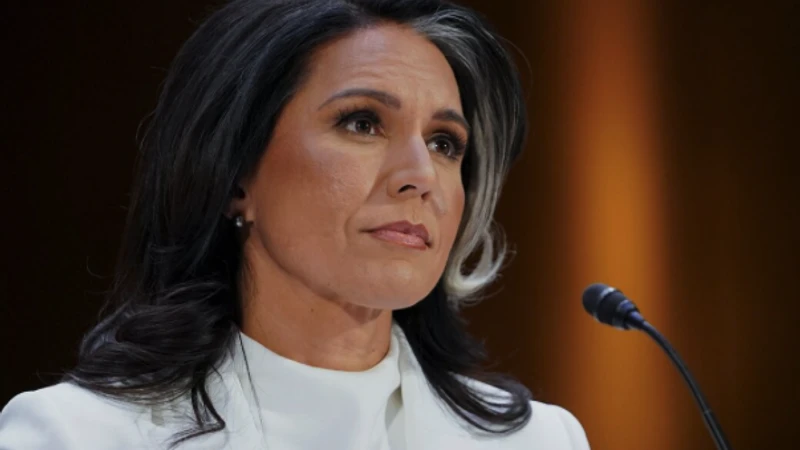
Director of National Intelligence Tulsi Gabbard has referred the alleged Ukraine impeachment whistleblower — believed to be former CIA analyst Eric Ciaramella — and the former Intelligence Community Inspector General who fast-tracked his complaint to the Justice Department for potential criminal investigation, the ODNI announced Wednesday. The criminal referrals mark the most consequential accountability action yet in the unraveling of one of the most politically charged episodes of Trump's first term.
The referrals come days after Gabbard's office, working with the House Intelligence Committee, declassified more than seven years of transcripts and supporting documents that Democrats and the intelligence community had kept under wraps since the fall of 2019. Those documents revealed, in stark detail, that the complaint accusing Trump of improperly pressuring Ukraine was built on no firsthand knowledge, driven by documented political bias, and laundered through an inspector general who manipulated his own process to give it credibility it did not deserve.
"Deep state actors within the Intelligence Community concocted a false narrative that was used by Congress to usurp the will of the American people and impeach the duly-elected President of the United States," Gabbard said in a statement accompanying the referrals. "Inspector General Atkinson failed to uphold his responsibility to the American people, putting political motivations over the truth."
What the Declassified Records Show
The newly public materials paint a damning portrait of a coordinated effort to weaponize the intelligence community's whistleblower process against a sitting president.
Ciaramella, a CIA analyst detailed to the National Security Council at the time, had no firsthand knowledge of Trump's July 25, 2019, phone call with Ukrainian President Volodymyr Zelenskyy. His complaint rested entirely on secondhand accounts from NSC colleagues. He was a registered Democrat who had previously worked closely on Ukraine policy under then-Vice President Joe Biden — including traveling with him to Ukraine. He had pre-complaint contacts with Democratic staff on the House Intelligence Committee, including aides to then-Chairman Adam Schiff, yet failed to disclose those contacts on his official disclosure form — an omission he later apologized for when confronted by investigators.
The declassified records also confirmed what was disclosed earlier this week: that Ciaramella acknowledged during the ICIG's review that he had a "prior professional relationship with one of the Democratic Presidential candidates" — a stunning admission of potential bias that former ICIG Michael Atkinson nonetheless chose to dismiss. "I did not find the complainant was biased," Atkinson claimed — a conclusion that the declassified record now makes extraordinarily difficult to defend.
Atkinson's Alleged Misconduct
The second criminal referral targets Atkinson himself, and the allegations against the former watchdog are serious. According to the declassified files, Atkinson deviated from standard procedures in multiple significant ways in handling the complaint.
He allegedly changed the whistleblower complaint form to accommodate hearsay information — lowering the evidentiary bar specifically to allow Ciaramella's secondhand allegations to proceed. He ignored Justice Department guidance that the complaint did not legally qualify as an "urgent concern" under the relevant statute. He did not review the actual transcript of Trump's call with Zelenskyy before certifying the complaint. And he conducted a narrow set of interviews in his preliminary review — including one with a witness who had co-authored the controversial 2017 Intelligence Community Assessment on Russian election interference and had documented ties to disgraced FBI agent Peter Strzok.
The ODNI general counsel's referral letter cited possible violations of federal criminal law by "one or more former employees of the intelligence community," specifically referencing Atkinson's 2019 congressional briefings. When Atkinson testified before the House Intelligence Committee in closed session in 2019, the transcripts of that testimony were withheld from Trump's defense team during the Senate impeachment trial and from the public for more than seven years. Their release this week has given investigators — and the American public — their first full look at what Atkinson said under oath and how it compares to what the declassified evidence now shows.
Seven Years Hidden From Trump's Defense
The constitutional dimension of this story cannot be overstated. Trump was impeached by the Democratic-led House in December 2019 and stood trial before the Senate in early 2020. His defense lawyers were never permitted to introduce the ICIG's own findings about the whistleblower's bias, hearsay reliance, false statements, and pre-complaint coordination with Schiff's staff — because Atkinson kept those findings classified.
Harvard Law professor emeritus Alan Dershowitz, one of Trump's impeachment defense lawyers, has said the suppressed evidence should have been "front and center" in the proceedings. Instead, the Senate and the American public were presented with the carefully curated nine-page letter that Schiff released — stripped of the admission that the whistleblower had no firsthand knowledge, stripped of the bias findings, stripped of the Schiff staff coordination, stripped of the apology for the false disclosure form.
That was not an oversight. It was a choice — one that Gabbard's criminal referrals now ask the Justice Department to evaluate as a potential federal crime.
The Democrats' Response
Schiff, now a United States Senator from California, had not commented publicly on the latest developments at the time of publication. A spokesman for the House Intelligence Committee as it was constituted under Democratic control in 2019 dismissed the entire declassification and referral effort as "a partisan stunt designed to rewrite history."
That characterization will ring hollow to the millions of Americans who watched the 2019 impeachment proceedings — conducted with great solemnity and urgency by House Democrats who presented the whistleblower as a credible, unbiased public servant with direct knowledge of presidential wrongdoing — and now learn that the intelligence community's own investigators had documented exactly the opposite, in writing, and kept it secret for seven years.
A Week of Accountability
The criminal referrals cap a remarkable week of rapidly accelerating accountability in the Russiagate and impeachment saga. The declassified memos revealing the suppressed ICIG evidence broke Sunday. The FBI announced it was "closely reviewing" the revelations Monday. Just the News founder John Solomon predicted a potential Brennan indictment within weeks on Tuesday, citing prosecutors' formal request for certified Senate transcripts. And now, on Wednesday, Gabbard has taken the most concrete accountability action yet — sending criminal referrals to the DOJ for both the alleged whistleblower and the inspector general who cleared his path.
The machinery of accountability, long stalled by the institutionalist resistance Gabbard has battled throughout her tenure, appears to be moving. Where it leads — and how quickly — may well define the legacy of Trump's second term.
The criminal referrals have been transmitted to the Justice Department. Ciaramella has not responded to requests for comment. Former ICIG Michael Atkinson has not yet issued a public statement. Senator Adam Schiff has not commented.
Gabbard Sends Criminal Referrals for Ukraine Impeachment Whistleblower and IG Who Covered for Him
- by: Ben Martin
- 2026-04-16
- Source:
patriotuncensored.com

- 04/16/2026
