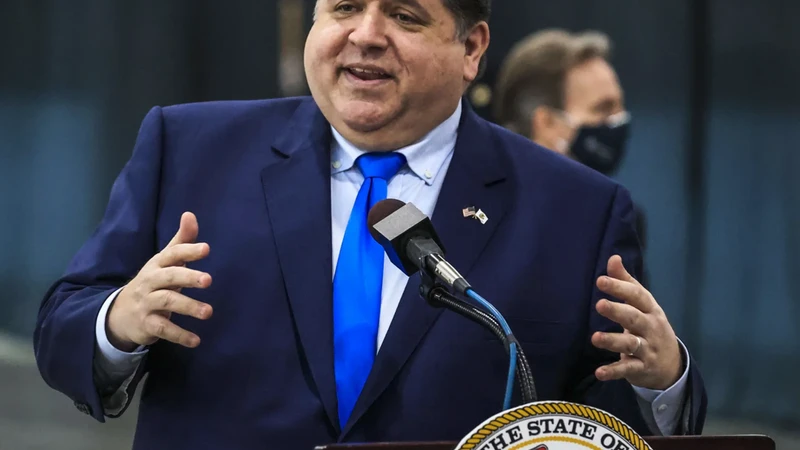
Illinois Democratic Governor JB Pritzker is pushing for criminal investigations into federal Immigration and Customs Enforcement agents and other federal officers involved in Operation Midway Blitz, escalating a confrontation between Illinois state government and the Trump administration's immigration enforcement apparatus that has been building for months.
Pritzker unveiled the recommendation Thursday at a press conference alongside the release of a more than 150-page report from the Illinois Accountability Commission — a body he created and whose eight members he personally appointed — that accused federal agents of "unconstitutional uses of force," alleged misconduct in more than a dozen specific incidents, and charged the Trump administration with lying about the operation's motivations and distorting key facts.
"Our communities and our people were subjected to an unprecedented campaign of harassment, intimidation and brutality," Pritzker said. "They deployed tear gas and smoke grenades against peaceful protesters and peaceful crowds and in peaceful neighborhoods. They committed flagrant and egregious abuses of power and force that went unchecked."
The Department of Homeland Security was having none of it.
"Governor Pritzker continues to refuse to do his job to protect his citizens from illegal alien crime and instead chooses to smear our law enforcement," DHS Acting Assistant Secretary Lauren Bis said in a pointed response. She also raised the case of Sheridan Gorman — an Illinois woman whose alleged killer was an illegal immigrant who had been released from jail under policies Pritzker's administration oversaw. "Where is the investigation into his own policies that allowed Sheridan Gorman's killer to be released from jail to go on and commit her heinous murder?"
Bis dismissed Pritzker's criminal investigation push as "nothing more than a political stunt" and raised a significant legal obstacle to the entire enterprise: "Federal officers acting in the course of their duties can only be investigated by other federal agencies. The states do not have the authority to run such an investigation."
A Commission of His Own Making
The Illinois Accountability Commission that produced the report recommending criminal investigations is not an independent body. It was created by Pritzker himself and staffed entirely with members he appointed — eight individuals including retired judges, a retired law enforcement official, former prosecutors, and a nonprofit leader. The commission investigated conduct by federal agents operating under federal authority and concluded that those agents should face criminal charges.
The conflict of interest embedded in that structure is difficult to miss. A governor who had already publicly vowed to seek criminal charges against Trump administration officials — a vow he made more than a month before Thursday's press conference — commissioned a report from his own appointees, and that report recommended exactly what he had already publicly promised it would recommend.
The report accused the Trump administration of lying about the motivation behind Operation Midway Blitz, alleged that "high-level White House, DHS and other federal officials enabled and encouraged misconduct by ICE and CBP agents" by urging agents to "go hard," and claimed agents engaged in shootings, beatings, indiscriminate use of chemical agents, and other alleged abuses.
Among the incidents the commission identified as warranting further investigation is the death of Silverio Villegas González, an illegal immigrant from Mexico who was shot and killed by ICE agents during the operation.
The Legal Reality
Beyond the political motivations at play, Pritzker's push for state criminal investigations into federal agents runs into a fundamental constitutional problem that Bis identified directly: states do not have the authority to criminally investigate federal officers acting in the course of their official duties. Federal law enforcement personnel conducting authorized federal operations are subject to federal oversight — not the criminal jurisdiction of a state whose governor is politically opposed to those operations.
This is not a technicality. It is a foundational principle of federal supremacy in the exercise of federal law enforcement authority. The Trump administration has not waited for Pritzker to figure this out — it has made clear that federal agents will not be subject to state criminal prosecution for conducting lawful immigration enforcement.
The same constitutional collision is already playing out in Minnesota, where Hennepin County Attorney Mary Moriarity issued a nationwide arrest warrant for an ICE agent who drew his weapon on individuals she claimed were civilian drivers — an action the agent said was taken in response to a perceived threat while anti-ICE activists were actively targeting federal vehicles on the day of a major enforcement operation.
The Record Pritzker Won't Discuss
Bis's pointed question about Sheridan Gorman cuts to the heart of the policy failure Pritzker would prefer not to examine. The victim's death — allegedly at the hands of an illegal immigrant who had been released from jail under sanctuary-friendly policies — represents exactly the human cost of the approach to immigration enforcement that Pritzker has championed. While the governor calls for criminal charges against the agents working to remove illegal immigrants from his state, a grieving family is asking why the man who allegedly killed their daughter was set free to do it.
The answer to that question does not appear in the 150 pages of Pritzker's commission report.
A Pattern of State Resistance
Illinois is not alone. Across the country, Democratic governors and local prosecutors have been escalating their resistance to federal immigration enforcement — from sanctuary policies that prevent local law enforcement from cooperating with ICE, to lawsuits challenging deportation operations, to now criminal referral recommendations targeting federal agents. Each escalation has pushed the constitutional confrontation between state resistance and federal supremacy further toward a point of direct legal reckoning.
The Trump administration has shown no indication it will back down. DHS continues its enforcement operations. The Justice Department is already examining the legal authority questions raised by the Minnesota ICE agent prosecution. And the administration's broader message — that federal law enforcement officers conducting lawful operations will not be subject to political prosecution by ideologically hostile state officials — is being tested in real time across multiple jurisdictions simultaneously.
Pritzker's criminal investigation push is the latest front in that battle. DHS's response was direct: it is a political stunt, it exceeds state authority, and the governor should answer for the Americans harmed by his own policies before he starts pursuing the agents trying to enforce the law he prefers to ignore.
The White House and the Illinois Attorney General's office had not responded to requests for comment at the time of publication. The DHS response was provided by Acting Assistant Secretary Lauren Bis.
Another Democrat Governor Calls for Criminal Investigations into Federal ICE Agents
- by: Ben Martin
- 2026-05-04
- Source:
patriotuncensored.com

- 05/04/2026
